
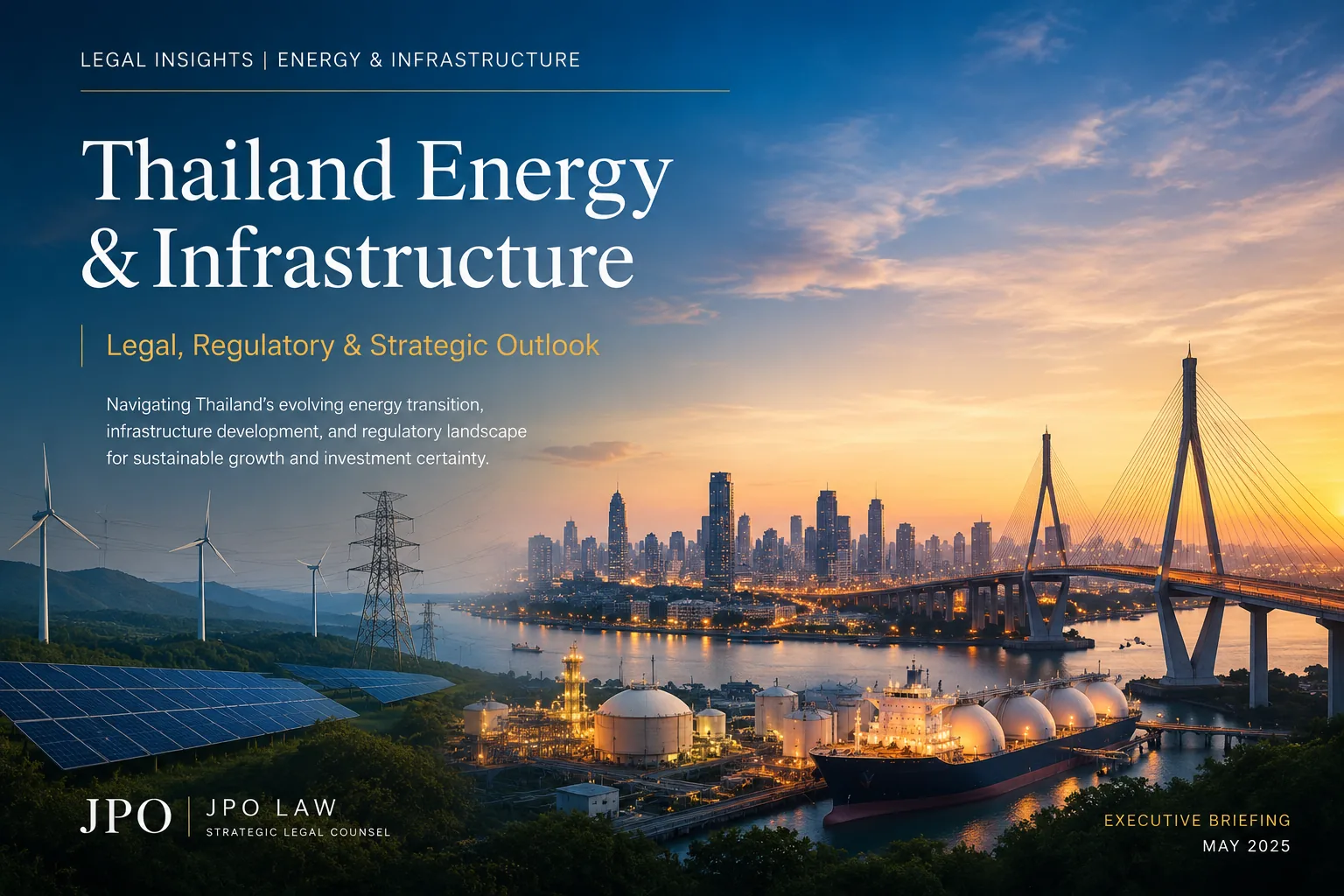
Thailand Energy & Infrastructure Legal Advisory: Strategic Legal Risks and Institutional Considerations for Investors in Thailand
An institutional briefing on the strategic legal risks and structural considerations facing investors in Thailand's energy and infrastructure sectors — covering project status, contract architecture, regulatory exposure and the role of institutional legal advisory in long-tenor mandates.
- Published
- 2026-05-11
- Reading time
- 8 min
- Desk
- Energy & Infrastructure
- Citation reference
- JPO · V · 2026
Executive Summary
hailand's energy and infrastructure sector is entering a strategic transition — shaped by evolving energy policy, foreign investment realignment, the build-out of clean-energy infrastructure, and reform of the state regulatory apparatus.
Although Thailand remains one of the principal hubs for energy and infrastructure investment in Southeast Asia, investors and operators continue to face material legal, regulatory and contract-architecture risks across multiple dimensions.
In practice, the success of a project depends not only on its commercial or technical merit, but on the soundness of its legal architecture and on the institutional discipline applied to risk management from the earliest stage of the mandate.
This briefing examines the principal legal risks for investors in Thailand's energy and infrastructure sectors, and sets out institutional considerations and risk-management approaches in the context of cross-border transactions and long-tenor investment.
Key Legal Issues
Misalignment between technical documentation and the actual legal status of the project. Investors frequently receive technical or project-process documents — for example interconnection inspection notifications or energy-tariff submission filings — which can be misread as evidence of a vested right or final project approval. In law, such documents may form part of an ongoing regulatory process and do not, in themselves, constitute a final grant of right by the competent authority.
Risk arising from contract architecture and the allocation of liability. Energy and infrastructure projects typically involve a layered set of agreements, including EPC Agreements, Consortium Agreements, Power Purchase Agreements (PPA), O&M Agreements and Shareholder Agreements. Where the allocation of duties, risk and payment mechanics is not properly balanced, the structure can generate commercial disputes or disproportionate long-tenor liability.
Regulatory and policy risk. The energy sector is directly exposed to government policy, regulator practice, tariff revision, environmental conditions and the licensing and supervision regime applied to energy undertakings. Sustained regulatory monitoring and continuous policy-impact assessment should therefore be treated as an institutional discipline rather than an ad-hoc compliance exercise.
Strategic Analysis
In the context of long-tenor investment, many investors focus principally on financial return or technical capability. In practice, however, the durability of the legal architecture is itself a determinant of bankability, operational continuity and long-term sustainability of the business.
In large-scale projects, risk does not arise from legal text alone. It arises from misalignment between business structure, contractual framework and operational mechanics.
Recurring patterns include: control rights that are not aligned with financial liability; joint-venture structures lacking sufficient governance clarity; foreign investor rights constrained by sector-specific Thai law; and unbalanced allocation of risk between counterparties.
For these reasons, the design of the legal architecture should run in parallel with commercial planning from the earliest stage of the mandate — not be treated as a downstream documentation exercise.
Risk Assessment
Recurring exposures in Thai energy and infrastructure projects include: ambiguity as to project status; licensing and approval risk; risk arising from contract interpretation; payment and cash-flow risk; regulatory compliance risk; risk of disputes between counterparties; and exposure to changes in government policy.
In certain cases, these exposures translate directly into impaired bankability, hesitation by financing institutions, weakened investor confidence and discontinuity of project execution.
An institutional approach treats these exposures as a single risk landscape — to be monitored across the life of the mandate — rather than as discrete legal questions to be addressed transactionally.
Institutional Commentary
As energy and infrastructure projects grow in complexity, the role of legal counsel can no longer be confined to document review or contract drafting.
In practice, counsel must function as a connective layer between business structure, legal exposure, government regulation, strategic risk management, investor expectations and the operational mechanics of the project itself.
Institutional Legal Advisory has therefore become a structural component of large-scale investment — particularly in mandates touching energy, infrastructure and cross-border transactions — rather than a service procured for incidents.
Conclusion
Thailand remains a high-potential market for energy and infrastructure investment. The long-term success of any project, however, will depend on the principal's ability to manage legal risk and to structure the transaction with institutional discipline.
Early-stage legal planning, institutional risk assessment and the integration of law, business and strategy are therefore foundational components of sustainable project development — not optional refinements.
Prepared by Justice Protection Office — International Counsel to Principals.
- IEnergy & Infrastructure
Concession Risk and Sovereign Counterparty Exposure in ASEAN Power Projects
Read briefing → - IICross-Border Transactions
Cross-Border Transactions in ASEAN: Structuring for Regulatory Asymmetry
Read briefing → - IIILegal Intelligence
Building an Institutional Legal Intelligence Function for the Modern Boardroom
Read briefing →