
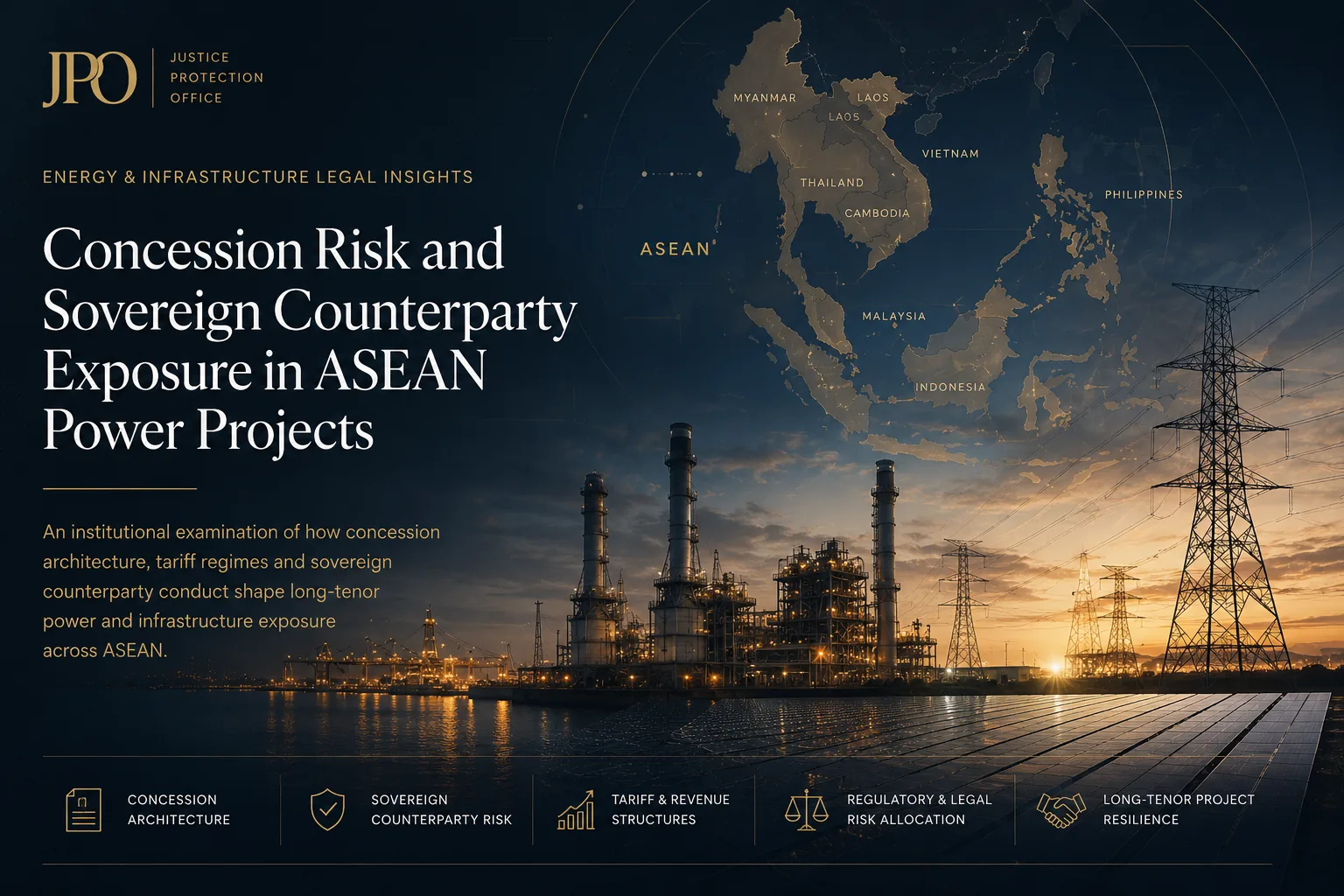
Concession Risk and Sovereign Counterparty Exposure in ASEAN Power Projects
An institutional examination of how concession architecture, tariff regimes and sovereign counterparty conduct shape long-tenor power and infrastructure exposure across ASEAN.
- Published
- 2026-05-12
- Reading time
- 9 min
- Desk
- Energy & Infrastructure
- Citation reference
- JPO · VI · 2026
Executive Summary
ong-tenor power and infrastructure investment across ASEAN is increasingly defined less by generation technology than by the architecture of the underlying concession and the credit conduct of the sovereign or state-linked counterparty standing behind the offtake.
Concession agreements, power purchase agreements and implementation contracts in ASEAN jurisdictions are typically structured around assumptions of sovereign tariff stability, regulatory continuity and disciplined counterparty performance over twenty- to thirty-year horizons.
In practice, those assumptions are tested by tariff revisions, renegotiation pressure, currency and indexation stress, and changes in the institutional posture of regulators and state-owned offtakers across successive policy cycles.
This briefing sets out an institutional view of the principal exposures embedded in ASEAN power concessions, and the structural disciplines that long-horizon investors and institutional sponsors should treat as a permanent feature of their risk architecture.
Concession Architecture and Allocation of Sovereign Risk
Concession architecture in ASEAN power projects is rarely a single instrument. It is typically a layered structure combining a concession or implementation agreement with the host state, a power purchase agreement with a state-owned offtaker, government support or guarantee letters, and a network of finance, EPC, O&M and shareholder agreements anchored on those state instruments.
The credit profile of the project is therefore a function of how risk is allocated across this layered structure — and, in particular, of which obligations sit at the sovereign level, which sit at the state-enterprise level, and which are pushed down to the project company.
Recurring structural exposures include the absence of a clear sovereign step-in or guarantee where one is commercially assumed, ambiguity as to the legal status of comfort or support letters, and asymmetric change-in-law and change-in-tariff provisions that allocate cost recovery to the project company without symmetric uplift mechanics.
An institutional review of concession architecture should therefore reconstruct the full obligation map — sovereign, regulator, offtaker and project company — and test whether the risk allocation actually delivered by the documents matches the risk allocation assumed in the financial model.
Sovereign Counterparty Conduct and Tariff Regimes
Across ASEAN, the credit characteristics of state-owned offtakers diverge materially from those of the sovereign itself. A state-owned utility may operate under tariff caps, cross-subsidy obligations and political pricing constraints that systematically compress its financial headroom, even where the sovereign rating remains investment grade.
Tariff regimes that rely on periodic regulatory adjustment — fuel cost pass-through, foreign-exchange indexation, capacity payments — are themselves a vector of counterparty risk where the regulator is institutionally exposed to political pressure or fiscal constraint.
Renegotiation pressure on legacy concessions, retroactive tariff revision and selective enforcement of curtailment provisions have become recurring features of the regional landscape, and should be modelled as base-case behaviours rather than tail risks.
A disciplined counterparty assessment therefore looks beyond sovereign rating to the institutional architecture of the offtaker, the political economy of the tariff, and the historical conduct of the regulator over multiple policy cycles.
Long-Tenor Risk Allocation and Bankability
Bankability of an ASEAN power project is determined less by headline economics than by the resilience of its risk allocation under stress scenarios — currency depreciation, fuel price volatility, regulatory revision and counterparty payment delay.
Lenders increasingly scrutinise the symmetry of force majeure and change-in-law regimes, the enforceability of termination compensation, the availability of foreign exchange convertibility and transfer protections, and the legal robustness of step-in and substitution rights.
Where the concession architecture concentrates residual risk on the project company without compensating mitigants, debt sizing, tenor and pricing all adjust — and the equity envelope thins to a point where the project ceases to be institutionally investable, regardless of its technical merit.
An institutional sponsor should therefore treat risk allocation as a primary commercial variable, negotiated with the same rigour as tariff and capacity, rather than as a residual legal exercise conducted after the commercial deal is set.
Institutional Commentary
Concession risk and sovereign counterparty exposure in ASEAN power projects are not exceptional events to be managed reactively. They are structural features of the regional infrastructure landscape, shaped by fiscal constraints, political economy and the long arc of regulatory reform.
Institutional sponsors and long-horizon investors should anchor their participation in this market on a permanent risk architecture: continuous concession monitoring, periodic stress-testing of counterparty conduct, and ongoing assessment of regulatory and political-economy signals across each jurisdiction in which they operate.
Editorial publications such as this briefing are intended to reinforce that institutional posture — providing executive principals with a calm, multi-jurisdictional frame for evaluating exposure rather than transactional commentary tied to a particular deal.
Conclusion
ASEAN remains one of the most strategically significant markets for long-tenor power and infrastructure investment globally — but the durability of returns in the region is increasingly defined by the strength of concession architecture and the credibility of sovereign counterparty conduct, rather than by underlying generation economics.
Investors and sponsors who treat concession risk and sovereign counterparty exposure as institutional disciplines, embedded in their governance and risk architecture from origination through operations, are materially better positioned to sustain long-horizon mandates across successive policy and political cycles.
Justice Protection Office continues to monitor concession architecture, tariff regimes and sovereign counterparty conduct across ASEAN power and infrastructure markets as part of its institutional Energy & Infrastructure intelligence mandate.
Prepared by Justice Protection Office — International Counsel to Principals.
- IEnergy & Infrastructure
Concession Risk and Sovereign Counterparty Exposure in ASEAN Power Projects
Read briefing → - IICross-Border Transactions
Cross-Border Transactions in ASEAN: Structuring for Regulatory Asymmetry
Read briefing → - IIILegal Intelligence
Building an Institutional Legal Intelligence Function for the Modern Boardroom
Read briefing →