
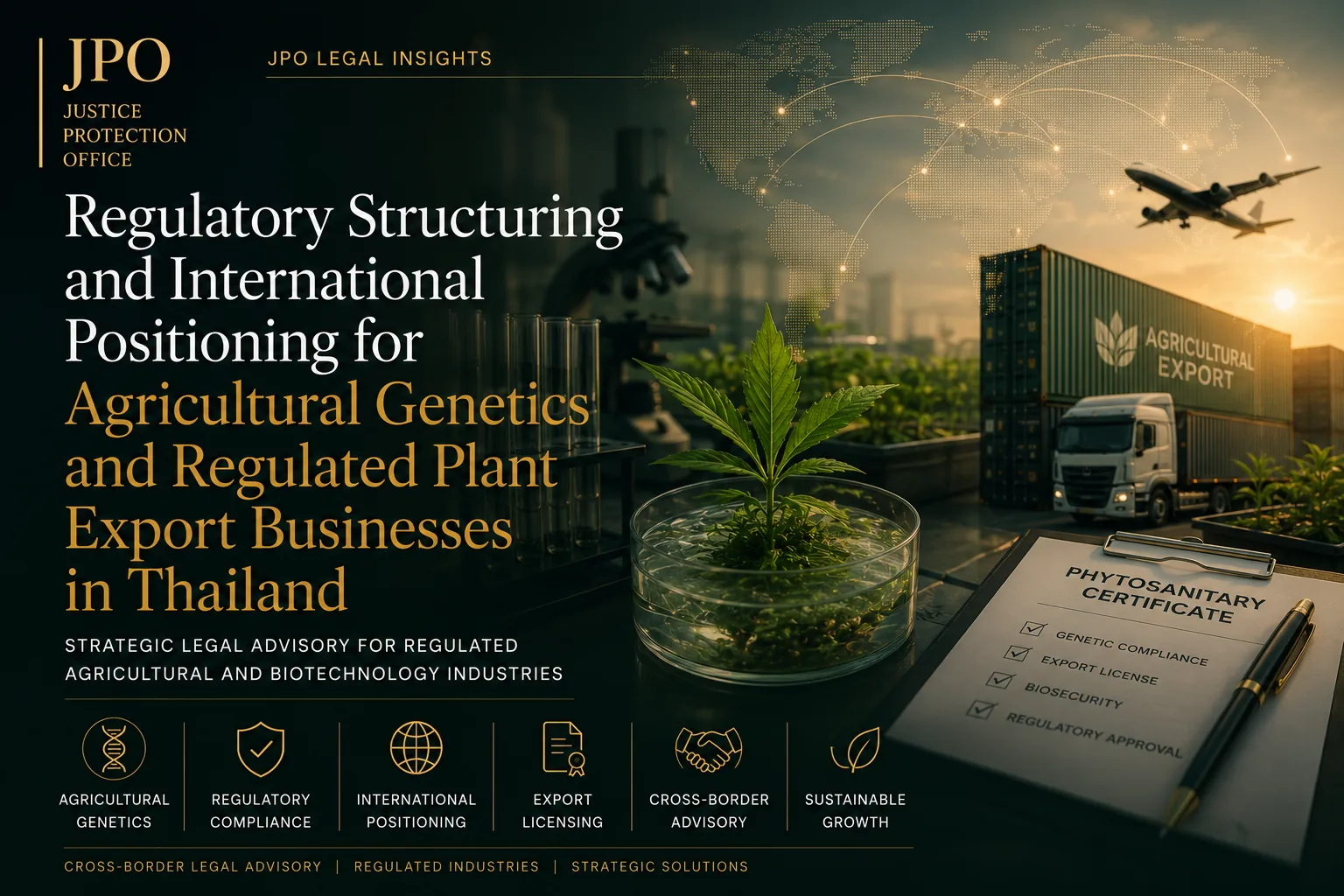
Regulatory Structuring and International Positioning for Agricultural Genetics and Regulated Plant Export Businesses in Thailand
An institutional briefing on regulatory positioning, agricultural compliance and international structuring for businesses operating in Thailand's regulated agricultural genetics, seed technology and controlled plant export sectors — with emphasis on institutional credibility, governance discipline and cross-border export readiness.
- Published
- 2026-05-11
- Reading time
- 9 min
- Desk
- Cross-Border Advisory
- Citation reference
- JPO · VI · 2026
Executive Summary
hailand's regulated agricultural and plant-based industries are undergoing significant structural transformation, particularly in areas involving agricultural genetics, seed technology, controlled plant propagation materials and export-oriented agricultural development.
The country continues to position itself as an emerging regional platform for regulated agricultural development, agricultural biotechnology and export-oriented plant-based industries within Southeast Asia.
In recent years, increasing international interest has emerged in Thailand's agricultural biotechnology capabilities — including plant breeding, germplasm development, controlled cultivation systems and cross-border agricultural commercialization.
However, businesses operating within these sectors frequently encounter substantial legal and regulatory complexities relating to licensing structures, agricultural compliance, phytosanitary controls, export regulations, foreign participation and sector-specific operational restrictions.
The legal and regulatory positioning of a company within this sector may significantly affect licensing eligibility, regulatory treatment, banking relationships, investor perception, export readiness and long-term operational sustainability. Businesses should therefore distinguish carefully between retail or consumer-oriented regulated plant operations on the one hand, and institutionally structured agricultural genetics and regulated export businesses on the other.
This briefing examines the principal legal, regulatory and strategic considerations relevant to the structuring of agricultural genetics, seed technology and regulated plant export operations within the Thai regulatory framework.
Key Regulatory Issues
Regulatory positioning of the business entity. One of the most consequential considerations is how the company is positioned and categorized from a regulatory perspective. Outcomes can differ materially depending on whether the company is structured as a retail regulated-plant business, a consumer-oriented lifestyle entity, a general trading platform, or an institutional agricultural-genetics and export platform. Regulators, banks, investors and commercial counterparties evaluate these categories differently in terms of compliance expectations, operational legitimacy and long-term risk. Careful drafting of company objectives, shareholder structures, licensing strategy and operational scope from the earliest stage of incorporation is therefore essential.
Agricultural compliance and phytosanitary regulation. Activities in plant genetics, seed development, germplasm research, controlled cultivation, plant breeding or propagation materials may attract supervision from multiple Thai agencies, including agricultural licensing requirements, import/export documentation, controlled plant-material rules, phytosanitary certification, R&D oversight and sector-specific operational approvals. Cross-border activity layers further obligations under international trade and agricultural-control frameworks.
International structuring and export readiness. Businesses targeting international agricultural markets should consider export-oriented corporate structuring, operational transparency, compliance documentation systems, supply-chain traceability, intellectual property protection, institutional governance frameworks and strategic regulatory advisory planning. International counterparties and investors increasingly expect GACP-oriented operational standards, regulatory documentation discipline, institutional compliance systems and clearly defined operational structures before entering into commercial or investment arrangements.
Strategic Structuring Analysis
In regulated industries, corporate structure is not merely an administrative matter — it forms part of the company's long-term regulatory identity. Businesses incorrectly positioned at the outset may later face licensing complications, banking restrictions, export barriers, investor concerns or reputational limitations.
Legal structuring should therefore be approached not solely as company registration, but as a combined exercise of regulatory positioning, strategic risk allocation, operational architecture, institutional governance, institutional risk management and long-term institutional planning.
Particularly in sectors involving regulated agricultural products and international export operations, institutional credibility may become one of the most valuable operational assets of the business.
In internationally regulated sectors, institutional governance, documentation discipline, regulatory transparency and cross-border compliance increasingly form part of the commercial credibility assessment conducted by investors, financial institutions and international counterparties.
Sophisticated investors and international counterparties now evaluate governance structure, regulatory discipline, operational transparency, compliance readiness, institutional stability and legal architecture alongside the underlying business opportunity itself.
Compliance & Risk Assessment
Recurring legal and operational risks within regulated agricultural genetics and export sectors include unclear regulatory classification, licensing uncertainty, phytosanitary non-compliance, export-documentation deficiencies, foreign-ownership restrictions, intellectual property disputes, contractual supply-chain disputes, inconsistent operational controls and cross-border regulatory exposure.
In certain circumstances, these exposures translate directly into impaired investment readiness, weakened institutional partnerships, fragile banking relationships, constrained export capability and discontinuity of long-term business operations.
Businesses operating in these sectors should therefore adopt proactive compliance, institutional governance, regulatory monitoring and institutional risk-management frameworks from the earliest stages of operation — and treat them as structural commitments rather than reactive measures.
Institutional Commentary
As regulated agricultural and biotechnology sectors continue to evolve internationally, the role of legal advisory increasingly extends beyond conventional documentation and transactional support.
In practice, institutional legal advisors are required to integrate regulatory analysis, operational structuring, international trade considerations, compliance systems, investor expectations, cross-border compliance, strategic regulatory advisory and strategic business positioning within a unified advisory framework.
This integration is particularly relevant in sectors involving regulated agricultural products, international export operations, agricultural biotechnology, controlled cultivation systems and cross-border commercial activities — where regulatory developments continue to evolve rapidly across multiple jurisdictions.
Conclusion
Thailand continues to present substantial opportunities for businesses operating within regulated agricultural genetics, seed technology and export-oriented agricultural sectors. Its evolving regulatory environment may further position the country as an increasingly relevant regional platform for regulated agricultural and biotechnology operations within Southeast Asia.
Long-term operational sustainability within these industries depends significantly on proper legal structuring, regulatory positioning, institutional governance, institutional risk management, cross-border compliance and proactive compliance management.
Businesses that approach these sectors through disciplined institutional planning and strategic regulatory positioning are likely to be substantially better positioned for international partnerships, investor engagement, export development and long-term operational credibility within increasingly sophisticated global agricultural and biotechnology markets.
In increasingly regulated international sectors, institutional credibility, regulatory discipline and governance transparency may become critical long-term differentiators for businesses seeking sustainable international growth.
Prepared by Justice Protection Office — International Counsel to Principals.
- IEnergy & Infrastructure
Concession Risk and Sovereign Counterparty Exposure in ASEAN Power Projects
Read briefing → - IICross-Border Transactions
Cross-Border Transactions in ASEAN: Structuring for Regulatory Asymmetry
Read briefing → - IIILegal Intelligence
Building an Institutional Legal Intelligence Function for the Modern Boardroom
Read briefing →